The End of an Era Premium
When Porsche retired the air-cooled flat-six after the 993 generation in 1998, the automotive world lost a piece of its soul. Nearly three decades later, air-cooled 911s have not only become the most actively traded segment in the collector car market, but they've also become a benchmark for appreciating classics, with prices that defy conventional market logic.
The appeal is straightforward: these are the last 911s built with the air-cooled flat-six configuration the car launched with in 1963, wrapped in the shape penned by Ferdinand Porsche's grandson, Ferdinand "Butzi" Porsche. The visceral mechanical connection is unmatched. Every water-cooled 911 since the 996 has been, in some philosophical sense, a different car. The air-cooled models represent the end of an unbroken mechanical lineage stretching back to 1963, a lineage that has seen the 911 win numerous races, including the 24 Hours of Daytona and the Monte Carlo Rally.
The 930 Turbo: Where It Started
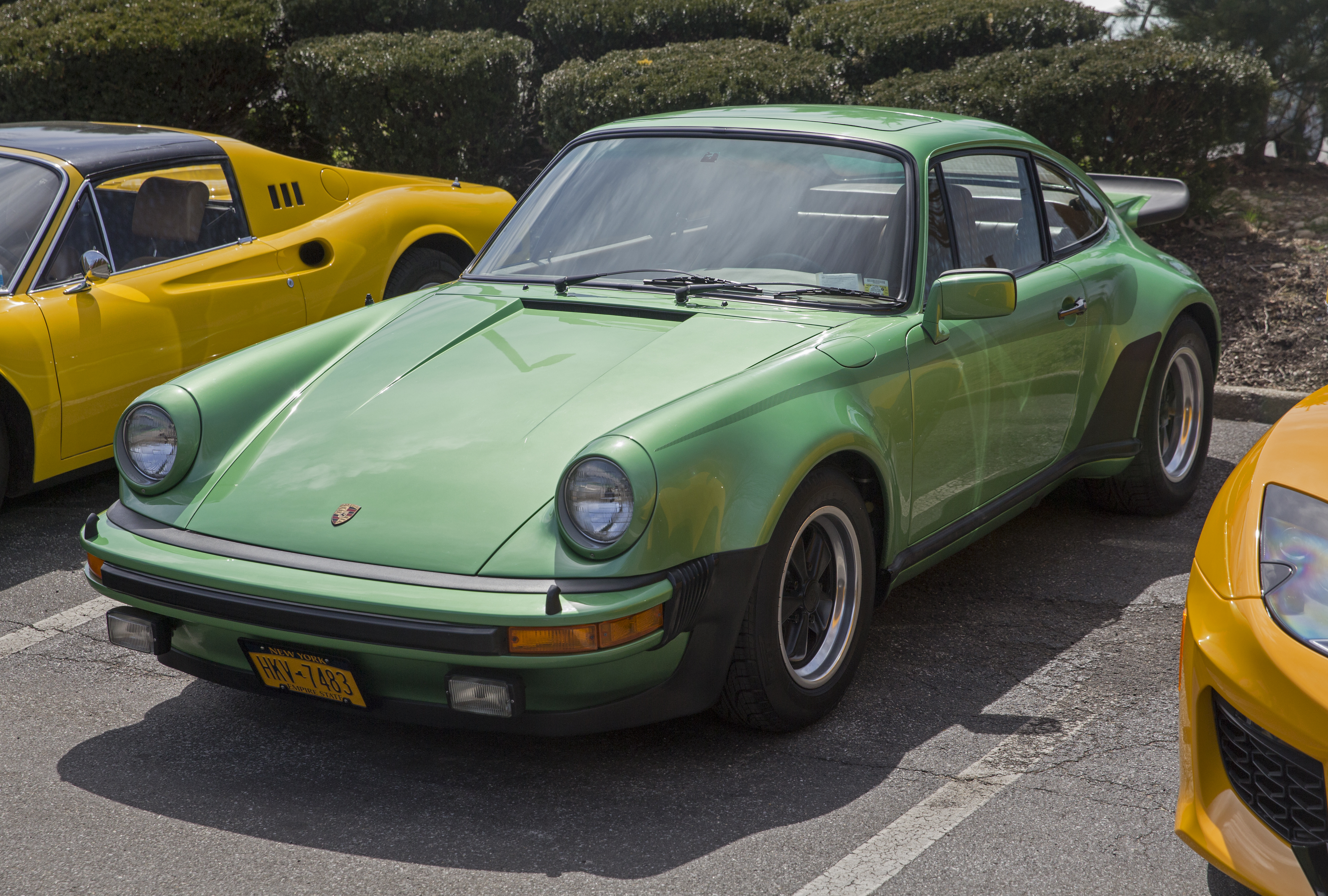
The 930 Turbo, produced from 1975 to 1989, was the car that turned the 911 from a sports car into a legend. Its 3.0-liter turbocharged flat-six (upgraded to 3.3 liters in 1978) delivered 260-300 hp in an era when most sports cars made half that. The iconic "whale tail" rear spoiler and widened rear fenders became design signatures that Porsche still references today.
Approximately 21,600 units were built across the full production run -- 2,819 with the 3.0-liter engine and 18,770 with the 3.3-liter. The car was notably absent from the US market between 1980 and 1985 due to emissions regulations, making US-spec examples from before and after that gap particularly desirable.
In our sold-price data for the last 24 months, the middle half of 930 sales sits between about $115,000 and $210,000 (€107,000–€196,000). Low-mileage, well-documented cars and the rare Flachbau (slant-nose) variants sit at the top of the market. The 930's racing pedigree, highlighted by its success in Group 4 and Group 5 racing, further cements its status as a collector's favorite.
The 964: The Underappreciated Middle Child
The 964 (1989-1994) was once considered the unloved generation. It introduced modern conveniences -- ABS, power steering, coil-spring rear suspension -- that purists initially dismissed. Its 3.6-liter M64 engine made 247 hp in standard Carrera form, and 360 hp in the 3.6 Turbo from 1993.
Approximately 63,762 units were produced, making it relatively common by 911 standards. But the market has reevaluated the 964. Standard Carrera 2 and 4 models now sell for $60,000-$120,000. The 964 Turbo 3.6 commands $150,000-$250,000 or more. The rare RS has broken well past those figures, while the RS America (only 701 built) now trades at Turbo 3.6 money.
The 964's rehabilitation illustrates a pattern in the collector car market: yesterday's compromise becomes tomorrow's sweet spot. The model's role in launching the Porsche Carrera Cup and Supercup one-make series has also played a part in its growing appeal.
The 993: The Crown Jewel
The 993 (1995-1998) is the holy grail -- the final air-cooled 911, and widely considered the most refined expression of the original concept. Its 3.6-liter flat-six made 272 hp in naturally aspirated form (282 hp with VarioRam), while the twin-turbocharged version delivered 408 hp. The Turbo S pushed that to 450 hp, thanks to larger turbochargers and an upgraded intercooler system.
Around 68,000 units were produced across all variants. But the special editions are where things get extraordinary:
- The 993 Turbo S (~345 units) regularly trades above $500,000
- The 993 GT2 (57 road cars plus 137 racers) has sold for £1.85 million (about $2.4 million) at auction
- Even standard 993 Carreras now command $80,000-$150,000
- 993 Turbos trade at $180,000-$300,000
The 993's racing success, including wins at the 24 Hours of Le Mans in the GT2 class, has only added to its mystique. Its advanced multi-link rear suspension, a first for the 911, offered a level of handling precision that set a new benchmark for the model.
The 912: The Forgotten Sibling

The 912 is often overshadowed by its more powerful siblings, but its place in Porsche history is undeniable. Produced between 1965 and 1969, and briefly resurrected in 1976 as the 912E, it was essentially a 911 with a 1.6-liter flat-four engine from the 356 (the 912E used a 2.0-liter VW unit), producing around 102 hp. This made it slower, but also lighter and more balanced.
Approximately 32,000 units were made in the initial run, with an additional 2,099 912Es built for the US market. The 912's simplicity and classic styling have earned it a dedicated following, with prices now ranging from $40,000 for drivers to over $100,000 for pristine examples. Its affordability compared to the 911 makes it an attractive entry point into the air-cooled world.
What the Data Tells Us
The air-cooled 911 market saw explosive growth from roughly 2015 to 2022, fueled by a combination of low interest rates, pandemic-era wealth creation, and a generational shift in taste. The COVID-era peaks brought some correction in 2023-2024, with prices softening 10-15% from the very top of the market.
But here's the key insight: the correction has been modest and selective. The best cars -- matching numbers, low mileage, documented history -- have held their value. It's the middle-of-the-road examples that gave back some gains. Notably, the market for rarer variants, such as the 993 GT2 and 964 RS, has remained robust, with auction prices often exceeding estimates.
Why the Trend Continues
Three structural factors support continued strength:
Finite supply. Unlike stocks, Porsche cannot issue more air-cooled 911s. Attrition from accidents, rust, and neglect slowly reduces the pool of survivors. The rarity of certain models, such as the 930 Turbo with the original 3.0-liter engine, further drives demand.
Expanding buyer base. The generation that grew up idolizing these cars (born 1975-1990) is now in its peak earning years. Meanwhile, younger enthusiasts are discovering them through social media and online auctions. The digital age has democratized access to these cars, with platforms like Bring a Trailer reaching global audiences.
The analog factor. In a world of increasingly digital, turbocharged, and electrified cars, an air-cooled 911 offers something irreplaceable: mechanical purity. No traction control on the early cars, no drive modes, no screens. Just a driver, a flat-six behind them, and the sound of an engine cooling its own cylinders with air. This analog experience is becoming rarer and more valued, as modern cars become more technologically complex.
The air-cooled 911 isn't just a car. It's become an asset class -- and the market continues to validate that status. As the collector car market evolves, the air-cooled 911 remains a touchstone of authenticity and timeless appeal.